How to Protect Your Property from Water Damage and Poor Drainage
Water damage doesn’t always begin dramatically. Instead, it’s often the result of a persisting issue that goes unnoticed for some time. For example, soil that retains water, a slowly leaking pipe, or a downspout directing water towards your home’s foundation. When you finally notice the damage, it may be too late.
Water Damage Is A Drainage Problem Before It’s Anything Else
Damage caused by water is the most common form of household disaster after wind and fire damage. Most people think about water damage in terms of the big things: a burst pipe, a flooded basement, a roof leak. However, it’s far more likely to be the result of a thousand smaller, common, often preventable water invasions.
Waterlogged soil around a foundation creates hydrostatic pressure – a slow, constant force pushing against the structure from outside. Over time, this pressure causes foundation cracks. These cracks give the water a path into the building, where it ruins floors, walls, furniture, and equipment and fosters the growth of bacteria, mold, and mildew (one of the largest sources of home-related illness).
The repair bill usually starts at $20,000 to $30,000. Repair and cleanup from just one-inch of water inside a building can cost up to $25,000 (FEMA). One inch. Block the drain first, and you’re halfway there. Or maybe the spraying water damaged the guttering, or a power outage killed the sump pump. Block the drain, the tubing breaks, and you’re almost all the way to $25,000.
The Hidden Work Of Tree Roots
In suburbs that have been around a while, the single biggest cause of blocked drains is tree root intrusion. It’s not a particularly exciting process – more of a slow, inevitable one that usually takes years for anyone to even realize is happening.
Contrary to what you see in movies, tree roots don’t dramatically smash their way into your pipes. Instead, they take the path of least resistance, finding the microscopic cracks in pipe joints that let in warm, moisture-rich air. Once a single hair-like root tip makes its way into the pipe, it thrives on the nutrient-rich sludge clinging to its structure. What used to be a small opening in the pipe has now developed into a real, substantial blockage, and by then, you’ve probably only just begun to notice that the drain’s running slow.
It doesn’t help that most residential plumbing is a generation behind modern engineering. Clay and concrete pipes, commonly used until the 1970s, are far more likely to have their joints separated by encroaching roots than PVC – but if your house was built long before then, you likely have old, vulnerable pipe running under your yard.
A CCTV drain inspection – where a waterproof camera is fed through the pipe – can reveal root intrusion without any need for excavation, letting you know exactly where the problem lies, how bad it’s gotten, and whether the pipe itself is still structurally sound. If you need a blocked drain plumber in Shoalhaven or anywhere else, catching root intrusion early means a good hydro-jetting can dislodge the contents. If, however, you let the problem go unchecked for years, then you’re up for a reline or partial replacement.
Early Warning Signs That Most People Ignore
There are many warning signs that indicate a drainage problem. However, since the drainage system is not visible, most homeowners tend to overlook these signals until it’s too late.
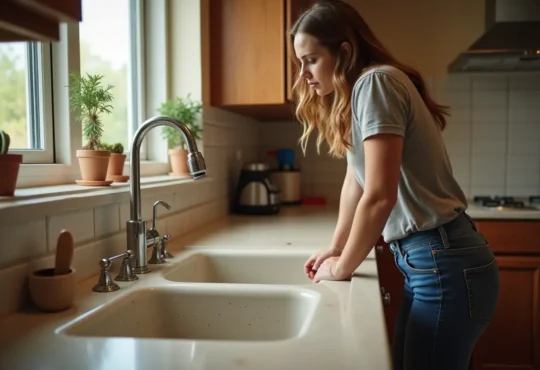
One of the most common clues is slow-draining fixtures. This means that sinks, showers, or tubs are draining slower than usual, which could indicate a blockage in the shared drainage line. If this happens simultaneously in multiple fixtures in the house, it’s a sign of a more serious problem in the system.
Another clear sign is hearing a gurgling sound coming from a bathtub or floor drain after flushing the toilet. This noise indicates that air is escaping through the drain because the water is not flowing properly.
If you get a strong, unpleasant smell coming from the drains or the yard, and you notice overly wet spots or constantly damp areas in the yard even during dry conditions, this is a sign that there is an underground leak or blocked pipe with organic waste decaying inside.
While all of these signs can be easy to ignore or dismiss, they are not to be taken lightly as they are a clear indication that a costly system failure can occur any time.
When It Stops Being A DIY Problem
A plunger and a hand snake can take care of an amazing number of household drain blockages – hair in a shower drain, food accumulating in a kitchen sink, minor grease building up near a trap. That’s all basic maintenance, and there’s no reason not to do it yourself.
The point at which you should pass the baton to a professional is when the problem is recurring, affects multiple fixtures, or comes at the same time as heavy rain. If you’ve cleared a drain three times in a year and it just keeps blocking, the blockage isn’t at the fixture level – it’s down the line somewhere. If you have drains backing up every time there’s a storm, you might have a stormwater issue, a cross-connection problem, or a partial collapse of the pipe.
And in those instances, it’s the kind of job that a plumber is going to do right, not just by clearing the problem in front of them but using a CCTV camera and checking out what’s actually causing the issue inside the pipe. Without that diagnostic step, you’re just clearing symptoms rather than fixing causes.
Storm backflow is a specific risk worth addressing with hardware. A backflow prevention valve installed on the sewer line stops sewage from being pushed back into the property when the stormwater network is overwhelmed. In flood-prone areas, it’s a relatively modest upgrade that prevents an extremely unpleasant and expensive event.
Grading And Surface Drainage – The Half Of The Problem That Isn’t Plumbing
The slope of the ground around your home matters more than you realize. Proper grading – where the soil drops at least six inches over the first ten feet from the foundation – keeps rainwater moving away from the structure rather than pooling against it.
In practice, grading degrades over time. Soil settles, garden beds get built up against the house, mulch accumulates along the wall line. The result is ground that slopes toward the foundation instead of away from it. Every rainstorm then delivers water directly to the most important structural part of the building.
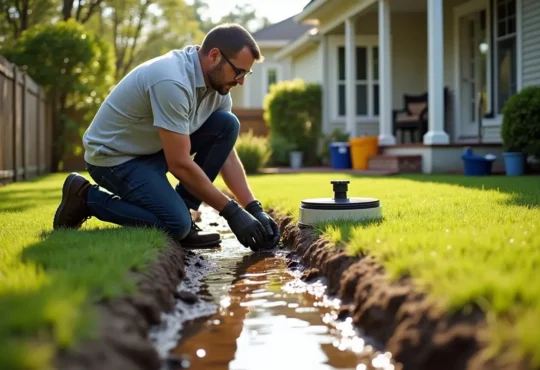
Regrading doesn’t always mean heavy work. Sometimes it’s as simple as pulling mulch back from the wall, adding topsoil to low spots, or redirecting a garden bed. For more serious cases, a French drain – a subsurface trench filled with gravel and perforated pipe – can be installed to intercept ground water before it reaches the foundation and redirect it safely away.
Erosion around the property edge is a visible indicator that surface drainage has already been failing for a while. Bare soil channels where water consistently flows, undercut edges near garden beds, or wash marks on concrete are all signals that runoff is uncontrolled and is concentrated in ways that will eventually cause damage.
Gutters And Downspouts – An Overlooked Drainage Entry Point
Gutters are designed to collect and direct rainwater from the roof away from the building. When they get clogged with leaves and other debris, they overflow. This doesn’t disperse across the yard in a nice, even sheet – it gushes out in a narrow strip right along the foundation, exactly the kind of localized, repeated saturation that promotes hydrostatic pressure and erosion.
The same thing happens with downspouts that empty right at the base of the wall. A downspout extension, a low-tech and very inexpensive feature, shifts the discharge point a few feet away from the wall, giving the water a chance to disperse before reaching the building.
Cleaning out the gutters twice a year (before and after the major leaf-fall period) is basic homeowner maintenance. If it’s a heavily-treed lot, you might need to do it more often. But keeping the gutters clear is only half the story – the weight of the debris and standing water can cause the gutter system to fail, leading to even more expensive repairs.
The Insurance Reality
Typically, gradual water damage such as water seepage, blocked drains breaking down over months, and ongoing roof leaks are not covered by standard home insurance policies. Most carriers do offer coverage as an add-on, but it’s pricey, and as you’d expect from anything titled “gradual water damage,” the threshold of what counts as sudden enough to activate the coverage is somewhat murkily defined. To make sure you never have to conduct an audit to prove your toilet break wasn’t really going on for months, keeping up with the maintenance that prevents gradual water damage in the first place is the smarter move financially.
Actions you’ve probably already been told to take, such as clearing your gutters, regrading your gardens so the water runs away from the house, and making sure your downspouts discharge water a good five feet away from the foundation – these go a long way to ensuring that insurance companies continue to enjoy collecting payments from you without ever making a claim.
Building A Routine Before Problems Start
A simple and cost-effective approach is an inspection routine scheduled before the seasons with the heaviest rainfall. Take a walk around the property after a heavy rain, and make a note of where water pools and runoff flows. Also, check if any drainage points are not working effectively. Before the wet season, inspect the gutters, and ensure they are clear. Additionally, look for any signs of erosion or soil settling near the foundation.
For properties located in higher-rainfall areas, or properties with older plumbing, large trees in the vicinity of drain lines, or a history of slow fixtures, a professional drain inspection every two to three years is recommended. This will give you a clear picture of the situation underground. It’s not a dramatic or costly measure, but it’s the type of maintenance that can help to catch any problems early on before they turn into costly failures.
Water damage doesn’t wait for the right time to occur. However, water also doesn’t appear out of the blue without a few warning signs beforehand. Pay attention to slow drains, damp soil, gutter overflows, or strange odors possibly coming from underground. Taking action early based on these warnings is generally easier, less costly, and less disruptive than waiting for things to escalate.

 Hi I'm Joe.